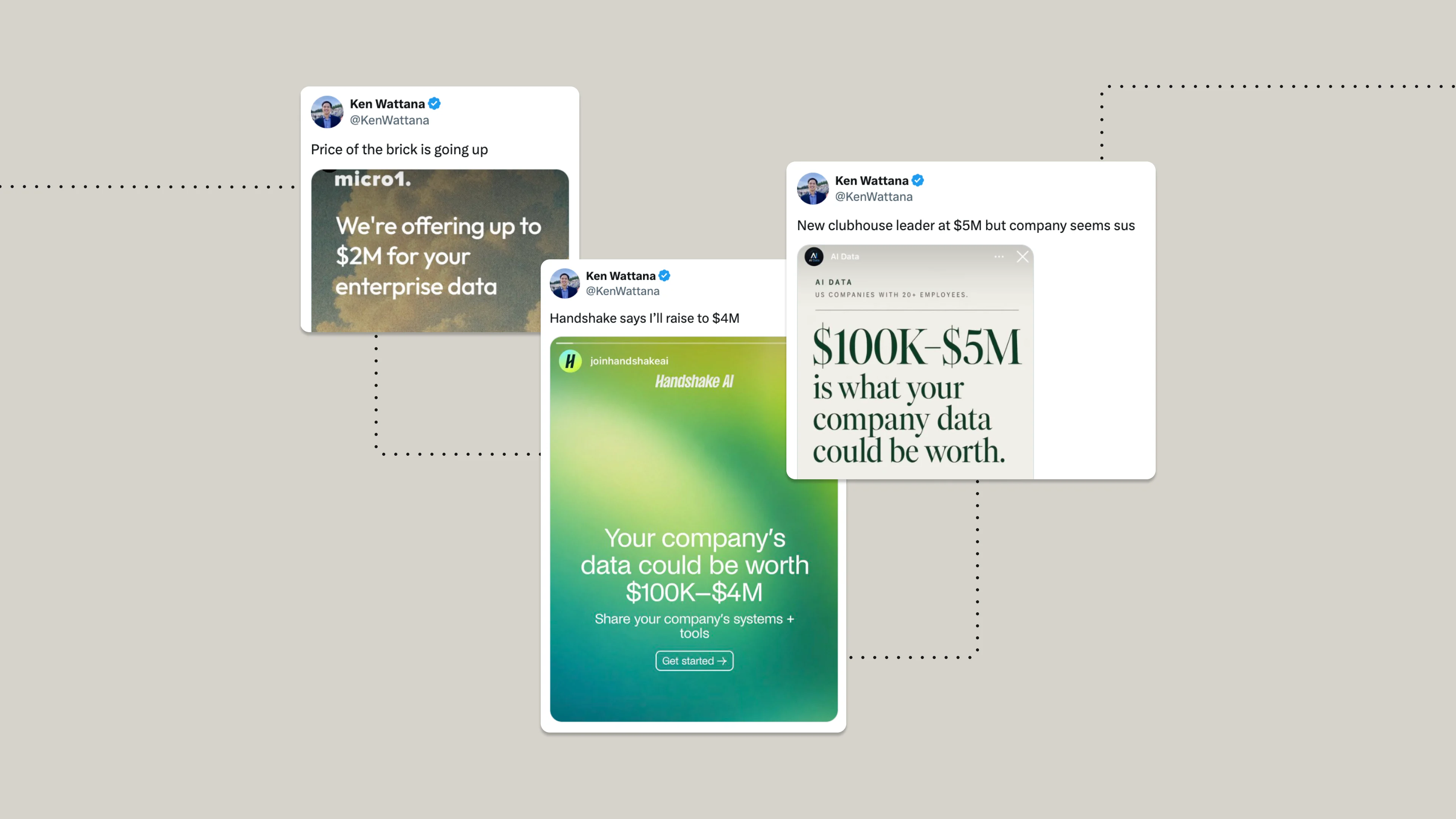

SimpleClosure is offering up to $10 million for your startup’s data.
No we’re not. But at the rate these announcements are escalating, give it a week until someone does offer this much.
Every day, another company seems to be putting out a new ad offering more money for enterprise data. First it was $1 million, then $5 million, and I’m sure someone is already working on the next one.
And yes, getting a seven-figure offer for something you previously considered operational exhaust can be a pretty effective ego boost.
But once the number gets interesting, you need to think beyond the price. What exactly are you selling? Who is buying it? And what happens to it afterward?
First, understand what you’re actually selling
“Startup data” isn’t one asset. Code, workspace data from tools like Slack and Notion, product databases, and media can have different buyers and different values. Even your codebase and the workspace documenting how it was built can be separately licensable, so bundling everything together shouldn’t necessarily be the default.
There’s also an important distinction between selling an asset outright and licensing access to it.
An exclusive deal may command a higher price, while a non-exclusive license preserves the ability to generate additional revenue from the asset over time. But whether that optionality is valuable depends on what happens to your company next.
For an operating company, licensing the same asset again may make sense. For a company that’s dissolving, ongoing revenue can mean keeping an entity alive to collect it, file taxes, maintain accounting, manage contracts, and take on continuing liabilities. At some point, preserving optionality can start to defeat the purpose of winding down.
There's consideration on the buyer's side, too. If the company that created the IP will no longer exist, an asset assignment can give the buyer clear ownership to maintain and defend that IP going forward.
So, think beyond the dollar value and consider what the deal means for your company after the sale.
More data isn't necessarily better data
Resist the temptation to dump your entire company history into a folder and call it a dataset.
Think deliberately about the surfaces you’re comfortable including. You might be comfortable sharing GitHub repositories, Linear or Jira tickets, Figma designs, Notion documentation, public Slack channels, and certain Google Drive files. You might feel very differently about Gmail, Slack DMs, HR information, or customer communications.
There’s also a value consideration here. A feature that can be traced from a Notion spec, to Figma designs, to Slack discussion, to a Linear ticket, to the corresponding GitHub code can provide much richer context than code alone.
The goal should be to maximize useful context, not indiscriminately maximize the amount of information handed over.
Remember whose information is inside the dataset
Company data is rarely just the founder’s data. It can contain information created by employees, customers, vendors, investors, and others who never expected their information to become part of an AI dataset.
That doesn’t necessarily mean those surfaces are off limits. It means you need to understand what’s in them, what you have the right to transfer, and what needs to be excluded or anonymized.
Some things shouldn’t be included at all: employee PII, protected health information, customer payment data, information covered by confidentiality agreements, third-party data you licensed rather than created, and live credentials like API keys or OAuth tokens. Code should also be reviewed for open-source licensing obligations.
Know what you have the rights to before you try to sell it.
Vet the buyer, not just the offer
A credible AI lab or data buyer should be able to explain exactly what happens between receiving your raw data and using the resulting dataset.
They should also be able to explain how they arrived at their offer. Depending on the asset, that could include the quality and complexity of the codebase, the amount of accompanying context, the number of contributors represented in a workspace, or the rarity of the underlying data.
It’s also worth understanding whether you’re selling to the end user of the data or an intermediary that will build on it and sell it downstream. Knowing where the buyer sits in that chain can help you understand both how your data will be used and where its value is coming from.
Before you sign, ask:
What exactly are you buying? Which data sources and rights are included?
How was the offer calculated?
Is the deal exclusive or non-exclusive?
What can the data be used for, and can the raw data be resold?
Who is responsible for removing PII and sensitive information?
Where is the raw data stored, who can access it, and is it encrypted?
Can the raw data enter any model workflow before it has been scrubbed?
What happens to the raw files after processing?
What rights or obligations do I retain after the transaction?
Permitted use should be explicit. If the data can be used for AI training but the raw corpus can’t be resold downstream, the agreement should say that. Don’t assume something is prohibited just because the contract doesn’t mention it.
Don’t underestimate the scrubbing problem
On paper, preparing a dataset sounds simple: export everything, remove the sensitive stuff, send the rest.
In reality, sensitive information can be scattered across years of Slack messages, Drive folders, tickets, source code, attachments, and metadata. Properly identifying and scrubbing it can take weeks or months if you’re trying to DIY it.
And who does the scrubbing matters. Ideally, the party preparing the data should be working on the seller’s behalf, rather than deciding what to remove after the raw data has already been handed to the buyer.
Most importantly, scrubbing shouldn’t happen after the buyer has already started using the raw dataset. Understand the chain of custody from raw data to usable dataset before anything changes hands.
Read the boring stuff
Congratulations, someone thinks your abandoned Jira tickets are worth millions. Unfortunately, you still have to read the contract.
Look specifically at ownership, licensing scope, exclusivity, permitted uses, sublicensing, data retention, confidentiality, security obligations, representations and warranties, indemnification, and what happens to derived data.
If you’re dissolving, pay particular attention to what obligations remain after the transaction. The goal isn’t necessarily to retain as many rights as possible. It’s to understand exactly what you’re transferring, what you’re keeping, and whether anything in the agreement creates an obligation that outlives the company.
Also confirm who is actually on the agreement, where the associated liability sits, and what happens to your rights if an intermediary or licensing entity is acquired or shuts down.
A headline purchase price can look very different once you understand the rights attached to it.
The best deal depends on what comes next
The emergence of a market for startup data is genuinely exciting. Assets founders once assumed would disappear with the company may have real value to the next generation of AI systems.
But maximizing that value shouldn’t mean uploading everything to the buyer with the biggest check.
The best transaction takes into account what happens next for your company.
If you’re continuing to operate, that may mean retaining more control over how your data can be used or licensed in the future. If you’re winding down, it may mean maximizing the value of the asset today while making sure the transfer is clean enough that you can actually move on.
Either way, understand what you’re selling, who you’re selling it to, and what obligations you’re taking with you after the deal is done.